
A clinical validation study of OneStep's Fall Risk Assessment reveals differences in both the likelihood and timing of falls, offering insights that may help clinicians prioritize care.
Falls remain a significant concern for healthcare providers, particularly when caring for older adults and individuals with mobility impairments.
Fall risk assessments play an important role in identifying vulnerable patients by evaluating factors such as balance, mobility limitations, medical history, and previous falls. However, in populations where many patients share similar risk factors, knowing who is at risk may not be enough to determine who needs attention first.
Consider two patients with impaired balance, reduced walking speed, and a history of mobility limitations. Both may be classified as high risk, yet their likelihood of experiencing a fall in the near future may differ substantially.
For healthcare teams working with limited resources, this distinction matters. Providers must determine who requires additional evaluation, closer monitoring, or targeted intervention, and how urgently.
The challenge is not simply identifying who is at risk, but understanding who faces the greatest near-term risk.
OneStep's Fall Risk Assessment (FRA) combines smartphone-based gait measurements with clinical history and functional assessment information to generate a standardized fall risk score.
During a short walking assessment, the OneStep app captures movement data to quantify gait characteristics such as walking speed, cadence, asymmetry, and turning.
Combined with additional clinical inputs, these measurements produce a continuous risk score from 0 to 100 and four risk tiers: Low, Medium, High, and Very High. The tiers provide a clear framework for communicating risk, while the continuous score offers additional detail for distinguishing between patients within the same category.
The real question, however, is do these differences in risk classification translate to meaningful differences in future fall outcomes?
A clinical validation study of OneStep's FRA evaluated 644 residents across senior living and post-acute care organizations, examining the relationship between baseline risk classifications and subsequent falls over 25 days.
The findings demonstrated meaningful differences in near-term fall risk across categories.
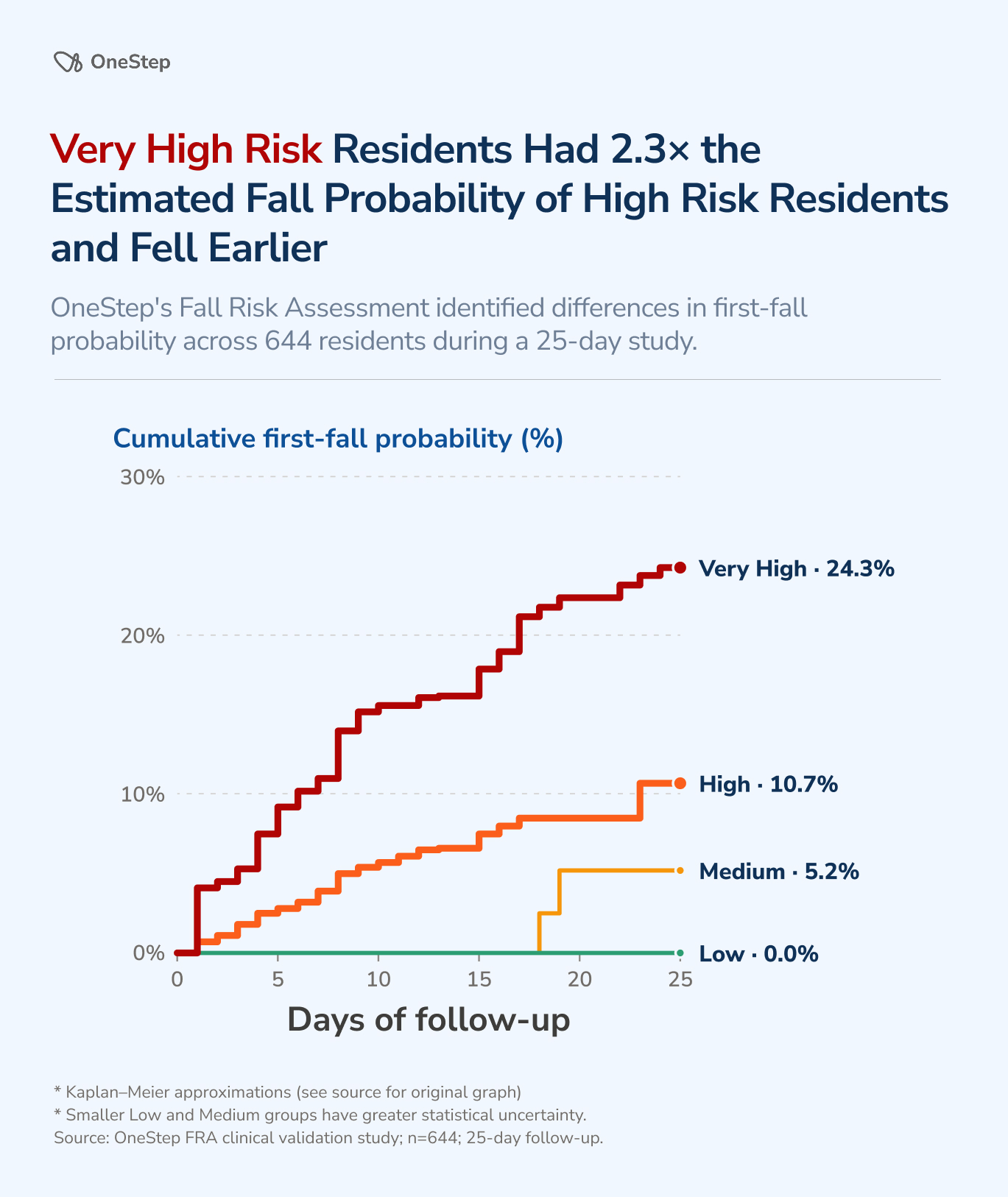
Residents classified as Very High risk had more than twice the estimated 25-day probability of falling compared with those in the High tier - that’s approximately one in four versus one in nine.
Importantly, the difference was not only in the likelihood of falling, but also in how quickly falls occurred.
The Very High risk group began experiencing falls earlier, with cumulative fall incidence rising more rapidly than in the High risk group. By Day 10, 36 first falls had already been recorded in the Very High tier.
These findings show that FRA risk categories were associated with differences in both the likelihood and timing of near-term falls, offering providers additional information about which patients may require more immediate clinical attention.
Note: The study evaluated senior living and post-acute care residents. Additional validation is needed to establish equivalent predictive performance in other healthcare populations.
Understanding both the likelihood and timing of falls can help providers prioritize care when many patients are considered vulnerable.
Patients identified as having greater near-term risk may warrant earlier clinical review, closer monitoring, or more immediate consideration for fall-prevention interventions. This information can also support decisions about where to focus limited clinical resources, including rehabilitation evaluations and follow-up assessments.
At the population level, standardized risk classifications can help care teams communicate priorities more consistently across clinicians and settings.
While further research is needed to determine whether FRA-guided interventions improve clinical outcomes, the validation findings highlight the potential value of incorporating near-term risk information into clinical decision-making.
When many patients are at risk, understanding who may fall sooner can help providers determine who needs attention first.
Explore the clinical evidence behind OneStep's Fall Risk Assessment and learn how objective mobility measurements can support more informed risk stratification and clinical prioritization.
Download the Complete White Paper
Clinical Validation of the OneStep Fall Risk Assessment in Senior Living, OneStep, 2026