
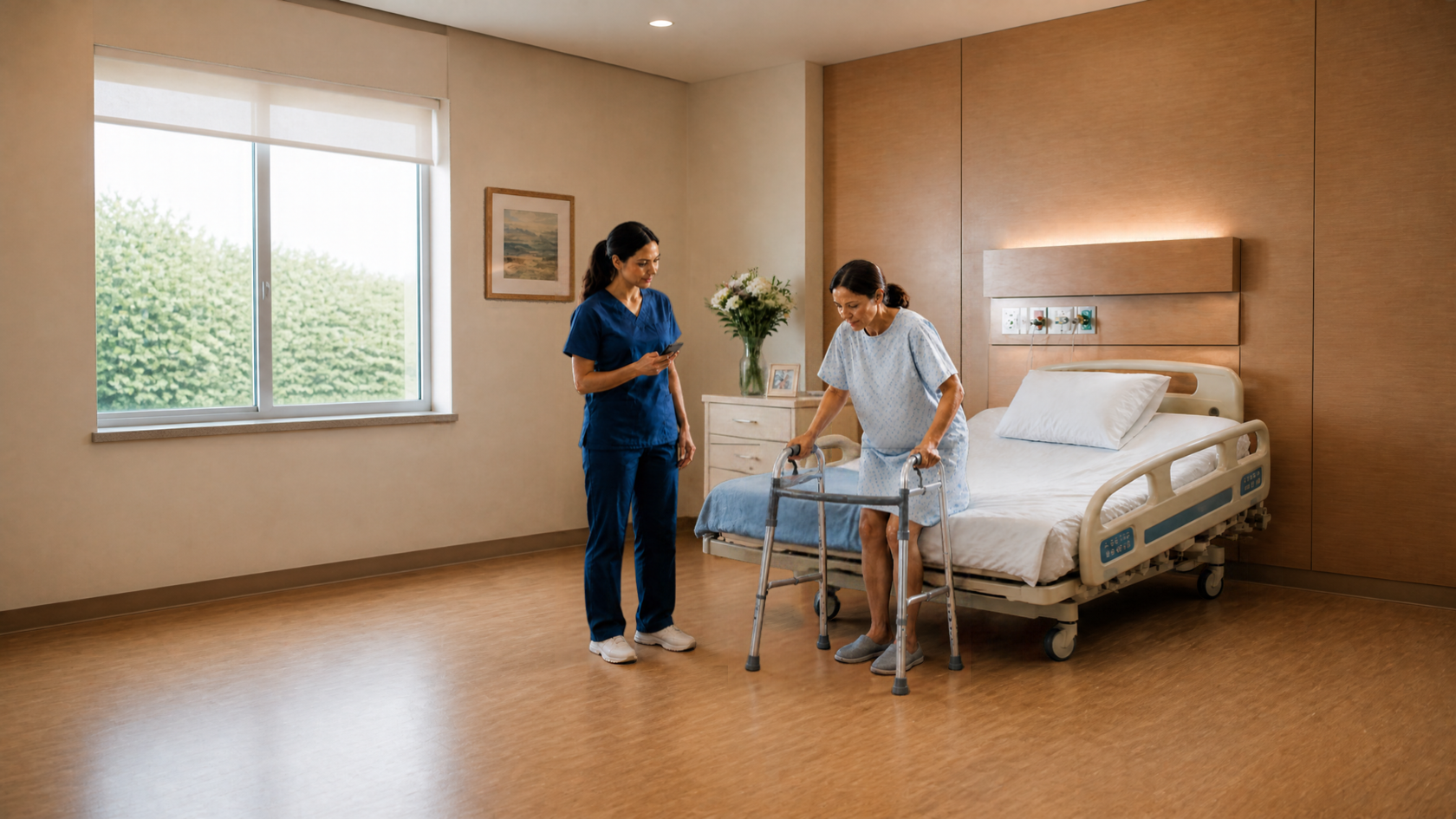
Every physical therapist who has worked in a skilled nursing facility speaks the same shorthand. Contact guard assist. Minimal assist. Supervision. We use these ratings dozens of times a day, and among clinicians they work. A colleague who reads “contact guard” knows to stay within arm’s reach.
But that shorthand was built for the person standing beside the patient. It was never meant for the organizations now accountable for that patient’s next 90 days. It says nothing about how fast someone walks, whether they are steadier than they were last week, or how they will manage once they are home alone.
As payment shifts to value-based models, that limitation is no longer just a clinical concern. It is a business problem.
For decades, skilled nursing facilities (SNFs) were judged by what happened inside the building: length of stay, therapy minutes, survey results. That frame is breaking down. In nearly every partner conversation I’ve had this year, the questions now reach past discharge.
Hospitals in hundreds of markets now carry financial responsibility for surgical episodes under CMS’s Transforming Episode Accountability Model, launched in January 2026. The LEAD model, a 10-year successor to ACO REACH, begins January 1, 2027. CJR-X, a mandatory joint replacement model, follows in January 2028. ACOs and Medicare Advantage plans are narrowing their preferred SNF networks.
Someone upstream now owns what happens after the patient leaves. A patient discharged home on day 14 who falls on day 20 lands on the hospital’s episode, the ACO’s spending and the SNF’s place in both networks. Accountability travels with the patient.
SNFs are not short on data. Claims show rehospitalizations, length of stay and discharge destination. EHRs hold vitals, medications and labs. Section GG captures function at admission and discharge.
What’s missing is objective, ongoing visibility into the thing most patients are in post-acute care to recover: their ability to move.
Function is still largely documented through observation and judgment. A rating of “contact guard” depends on who is watching, on what day and in what setting. It is captured at a few points in time, then rarely again. Between therapy sessions, overnight and especially after discharge, function is close to invisible.
That matters because decline rarely announces itself. A urinary tract infection, a medication change, dehydration or new pain often shows up first as a change in how someone moves. They walk a little slower. They get up less often. Their steps shorten. By the time the change reaches the chart, it is often a fall, an emergency department visit or a transfer back to the hospital.
We monitor heart rate and blood pressure because they warn us early. Mobility can do the same. In most SNFs, it is measured occasionally, not consistently.
Movement Intelligence is the practice of measuring how people move, objectively and repeatedly, and turning those measurements into decisions. Gait speed, cadence and step symmetry are well-studied markers of function and fall risk. Gait speed in particular has been called the “sixth vital sign” in geriatric research.
What has changed is access. Measuring gait once required a lab, a pressure mat or wearable sensors. Today, key gait measures can be captured with a smartphone during a short hallway walk or a normal day at home.
When movement is measured the same way every time, three things become possible.
First, change becomes visible early. A patient whose gait speed slides below their own baseline can be flagged for review before a fall or a hospital transfer, not after.
Second, recovery becomes provable. Instead of “improved,” a facility can show how much a patient’s function changed from admission to discharge, measured consistently for every patient.
Third, the picture survives the handoff. The next provider receives actual mobility data rather than a single line of narrative.
Early real-world data is encouraging. At this year’s AHCA/NCAL convention, OneStep and a skilled nursing rehab partner shared that facilities doing more mobility screening saw 17.8% fewer falls and 9.3% fewer rehospitalizations. That is a correlation, not proof, but it matches what many clinicians believe: what gets measured consistently gets managed earlier.
Most SNFs are still organized around events. Fall risk is assessed at admission and revisited after a fall, even as insurers now ask about it. Function is reassessed at discharge.
Objective, ongoing movement data changes that model. Instead of reacting to a fall, a team can respond to the trend that preceded it. Instead of debating discharge readiness, a team can look at how the patient is actually moving. Instead of telling an ACO that outcomes are strong, a facility can show it.
None of this requires a new department. It requires the whole team, including nursing, aides, therapy, the medical director and the administrator, looking at the same objective view of each patient. When that view changes, a nurse and a physician or NP review it within 24 hours, and someone owns the follow-up.
The larger opportunity is a shared language. Today, each partner describes the same patient’s function in different terms, often subjectively. Objective functional outcomes give every partner across the continuum a common reference point. That can make transitions safer, network decisions fairer and value easier to demonstrate.
Value-based care asks a hard question of every skilled nursing facility: can you prove your patients are better off because they came to you?
Clinical skill, a caring team and a responsive medical director all matter. But they are invisible to the analyst deciding where patients go next. What holds up is evidence, and the most meaningful evidence in post-acute care is whether a patient can move safely and independently.
Function is the outcome everyone cares about. Movement is how we measure it. The SNFs that treat mobility as a vital sign, rather than a line in a note, will be the ones their partners trust.
This article draws on insights from Patrick Tarnowski’s LinkedIn post, “5 Questions ACOs Will Ask Your SNF.”