

Every senior living organization measures resident mobility.
The challenge isn't whether measurements are being taken, it's when they're taken.
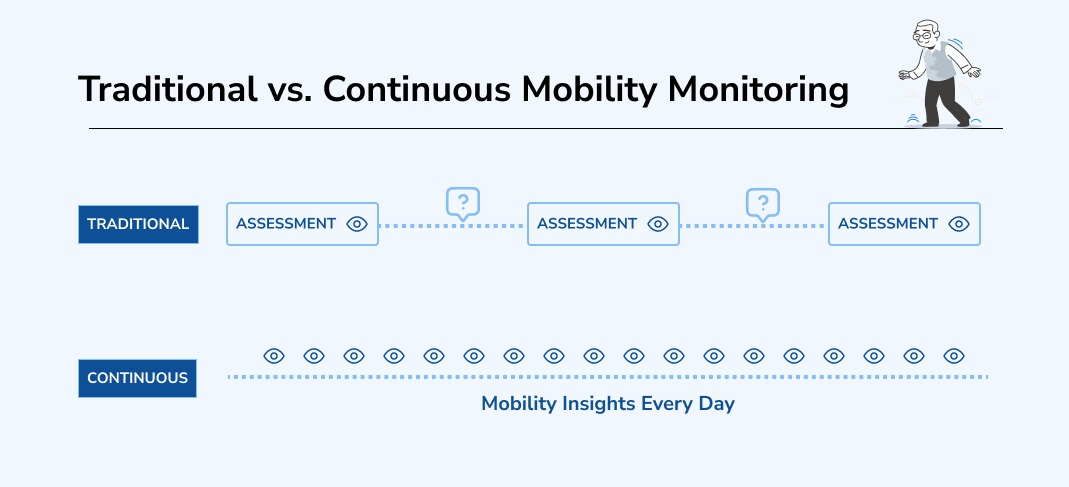
Most mobility assessments happen during scheduled therapy visits. They provide valuable clinical information, but they also leave long periods where changes in a resident's functional status may go unnoticed.
A resident's mobility can improve, plateau, or decline days before the next formal assessment.
By the time that change is identified, the opportunity for early intervention may already have passed.
For rehabilitation leaders and operators, this raises an important question:
Would more timely visibility into resident mobility lead to better clinical decisions?
Most therapy teams would welcome more frequent insight into resident mobility.
The obstacle has never been clinical value, but rather operational capacity.
Collecting more mobility measurements traditionally meant scheduling more assessments, creating more documentation, and asking therapists to spend additional time measuring instead of treating.
In an environment where staffing and productivity are constant pressures, that's difficult to justify.
So organizations have largely accepted periodic assessments as the practical limit.
Today, collecting mobility data doesn't necessarily require more clinician time.
Using smartphone-based mobility monitoring, residents simply carry their phones throughout the day as they normally would. Objective mobility measurements can be collected continuously during everyday activities, giving clinicians visibility into mobility between scheduled visits.
Formal assessments remain an essential part of rehabilitation.
What's different is that clinicians no longer have to rely solely on those assessments to understand how residents are progressing.
Instead of adding work, technology fills in the gaps between visits.
To better understand whether measurement frequency influences recovery, OneStep analyzed mobility data from more than 5,000 patients across six healthcare organizations between 2023 and 2025.
The analysis found a consistent pattern:
Organizations with higher mobility measurement frequency also demonstrated greater improvements in population gait speed over time.
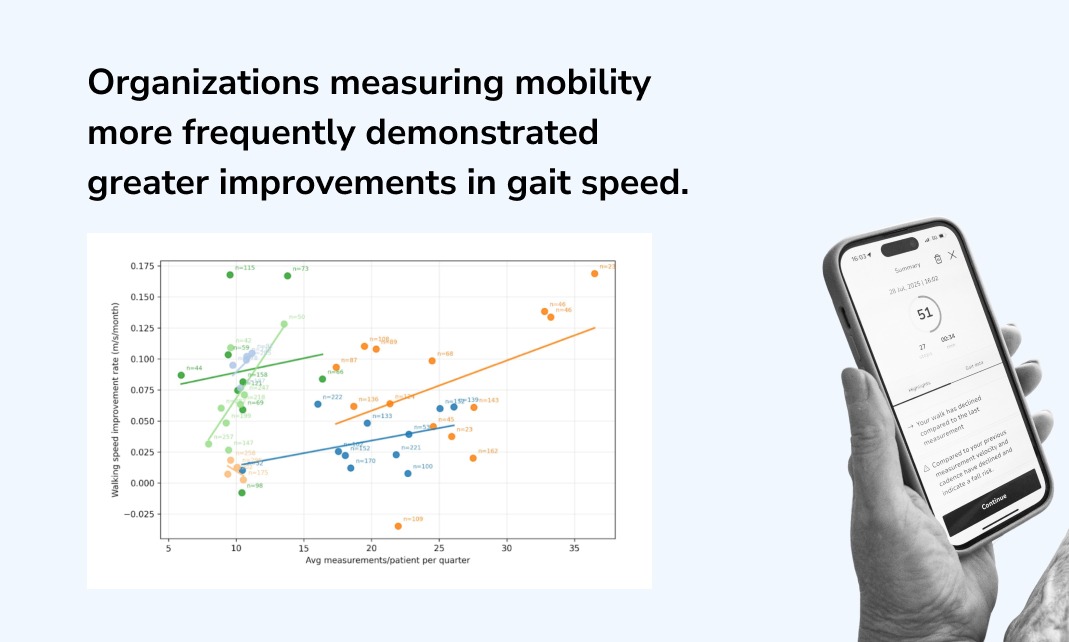
The findings identify an association, not proof, that more frequent measurement alone causes better outcomes.
However, they support a practical hypothesis:
When clinicians have more timely visibility into mobility, they can identify stalled progress earlier, adjust treatment sooner, and keep therapy aligned with how residents are functioning in daily life.
Rehabilitation programs are ultimately judged by outcomes.
Improving those outcomes depends not only on the quality of therapy, but also on how quickly clinicians recognize when a resident's needs have changed.
Continuous visibility into mobility helps shorten the time between functional change and clinical response.
That creates opportunities to:
For operators, that means better oversight of rehabilitation performance without increasing demands on already busy therapy teams.
Traditionally, mobility measurement has been viewed as documentation.
Something that records recovery.
The findings from this analysis suggest it can play a more active role.
When mobility is measured consistently, clinicians gain earlier awareness of changes that might otherwise remain hidden until the next appointment.
That allows treatment decisions to become more responsive to what's happening in real time rather than what happened during the last scheduled assessment.
Measurement becomes more than an outcome metric.
It becomes another clinical input that helps guide care.
The question for senior living organizations is no longer whether more frequent mobility data would be valuable. Most leaders would agree that it would.
The real question is whether that visibility can be achieved without creating additional work for rehabilitation teams.
Digital mobility monitoring makes that possible by using smartphones residents already carry, allowing objective mobility data to be collected throughout daily life instead of relying solely on periodic assessments.
For operators, the opportunity is straightforward:
Better visibility into resident mobility.
Earlier clinical decisions.
More proactive rehabilitation.
Not because therapists are doing more assessments, but because they have better information.
How often does your program measure mobility? See how measurement frequency tracked with gait speed improvement across six organizations.