

For decades, physical therapists (PTs) have relied on "the naked eye" and manual stopwatches to assess how a patient walks. While the clinical intuition of a seasoned PT is invaluable, human observation has its limits. It's subjective, difficult to reproduce between different therapists, and lacks the granular data needed to catch subtle changes in a patient’s recovery or fall risk.
Today, forward-thinking physical therapy clinics are embracing digital solutions to complement their clinical skills. By adopting objective gait analysis technology, clinics are moving beyond "patient demonstrates steadier movement" to "patient’s step length has increased by 15%."
Here is a look at how modern PT clinics are measuring gait objectively and why it matters for patient outcomes.
Perhaps the most disruptive technology in the space is the one already in your pocket. Modern smartphones are packed with sophisticated inertial measurement units (IMUs)—including accelerometers and gyroscopes—that can track movement with incredible precision.
Platforms like OneStep utilize these internal sensors to turn a smartphone into a medical-grade gait lab. By simply placing the phone in a patient's pocket or attaching it to their thigh with a strap, therapists can capture real-time, lab-quality gait metrics without the need for bulky, expensive equipment.
As Tomer Shussman, CEO of OneStep, highlighted in a recent industry webinar:
"We realized that with any smartphone in your pocket you can conduct assessments like fall risk assessments or gait and mobility assessments... when you analyze how a person walks, you can actually understand who is more likely to fall." — Smarter Tech, Better Care (Part 1): OneStep & Innova transform documentation, outcomes & revenue
For the patient, the biggest benefit of objective technology is that care no longer stops at the clinic door. When sensors—particularly smartphone-based ones—are used, PTs gain visibility into how a patient walks in the "real world," not just during a 30-minute appointment.
Objective gait analysis transforms the patient’s psychological journey. When a recovery is slow, patients often feel like they aren't improving, which can lead to burnout and missed appointments.
Transitioning to objective measures isn't just about having cool gadgets; it's about addressing clinician burden and burnout. By replacing manual, repetitive tasks with automated data capture, PTs can reclaim time for hands-on treatment while generating the high-fidelity reports required for modern reimbursement models.
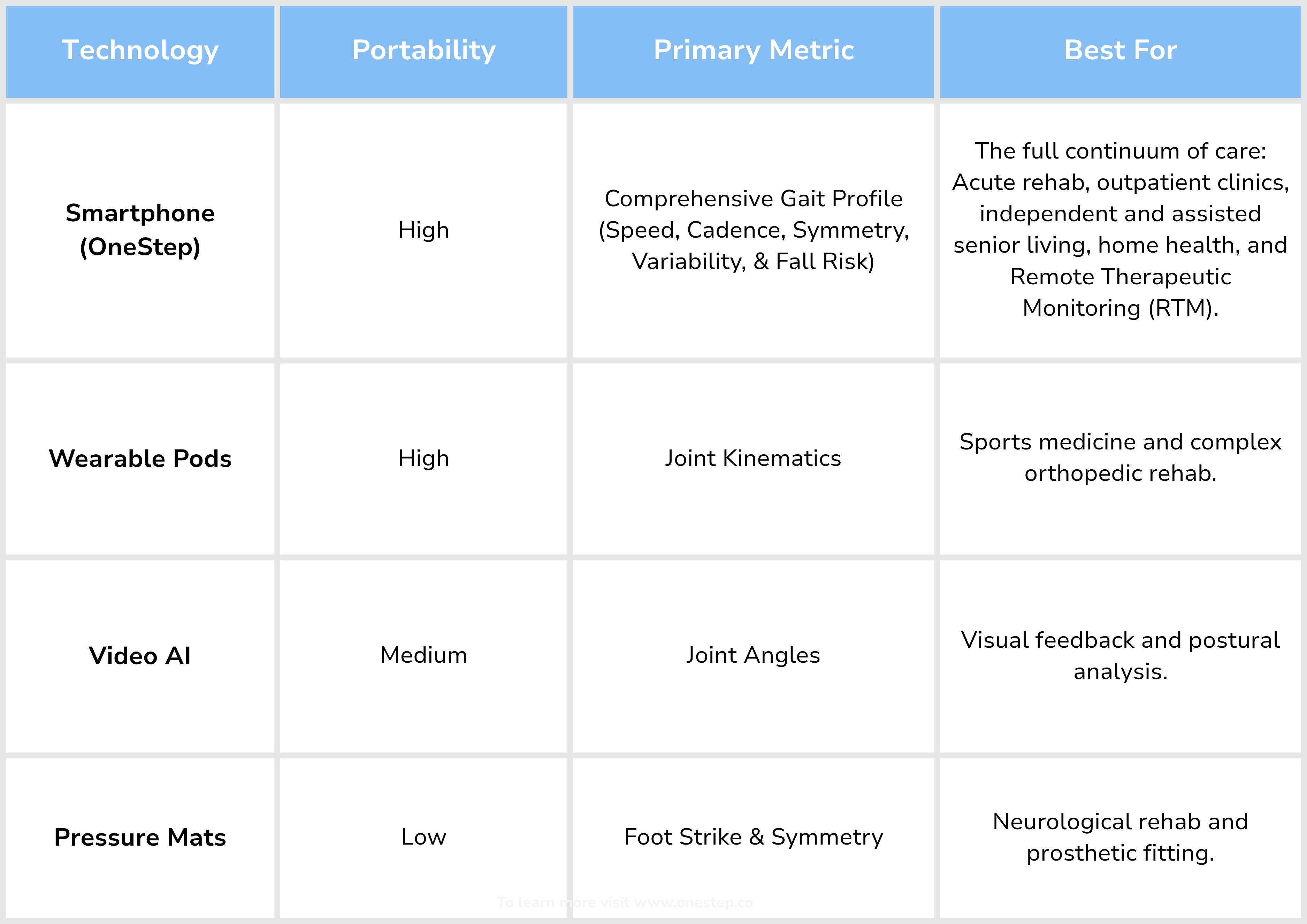
While the benefits of objectivity are clear, the right technology depends on your clinic's specific patient population and workflow needs. The following table compares the most common digital tools used today to help you determine which gait analysis solution best supports your clinical goals.
The shift from manual stopwatches to digital sensors isn't just a technical upgrade; it is a fundamental shift in the quality of care. By removing the guesswork from gait analysis, PTs can provide more accurate diagnoses, create highly personalized treatment plans, and prove the efficacy of their work through objective data.
With objective gait analysis, clinics are ensuring every step a patient takes is measured, every improvement is celebrated, and no subtle sign of decline goes unnoticed. In the modern PT landscape, the best way to move forward is by knowing exactly how your patients are walking today.