CJR-X Is Final: What Changes for Hospitals in 2027 and 2028

CJR-X isn't TEAM with a longer clock. For many hospitals, it will be the first bundled payment model they have ever joined.

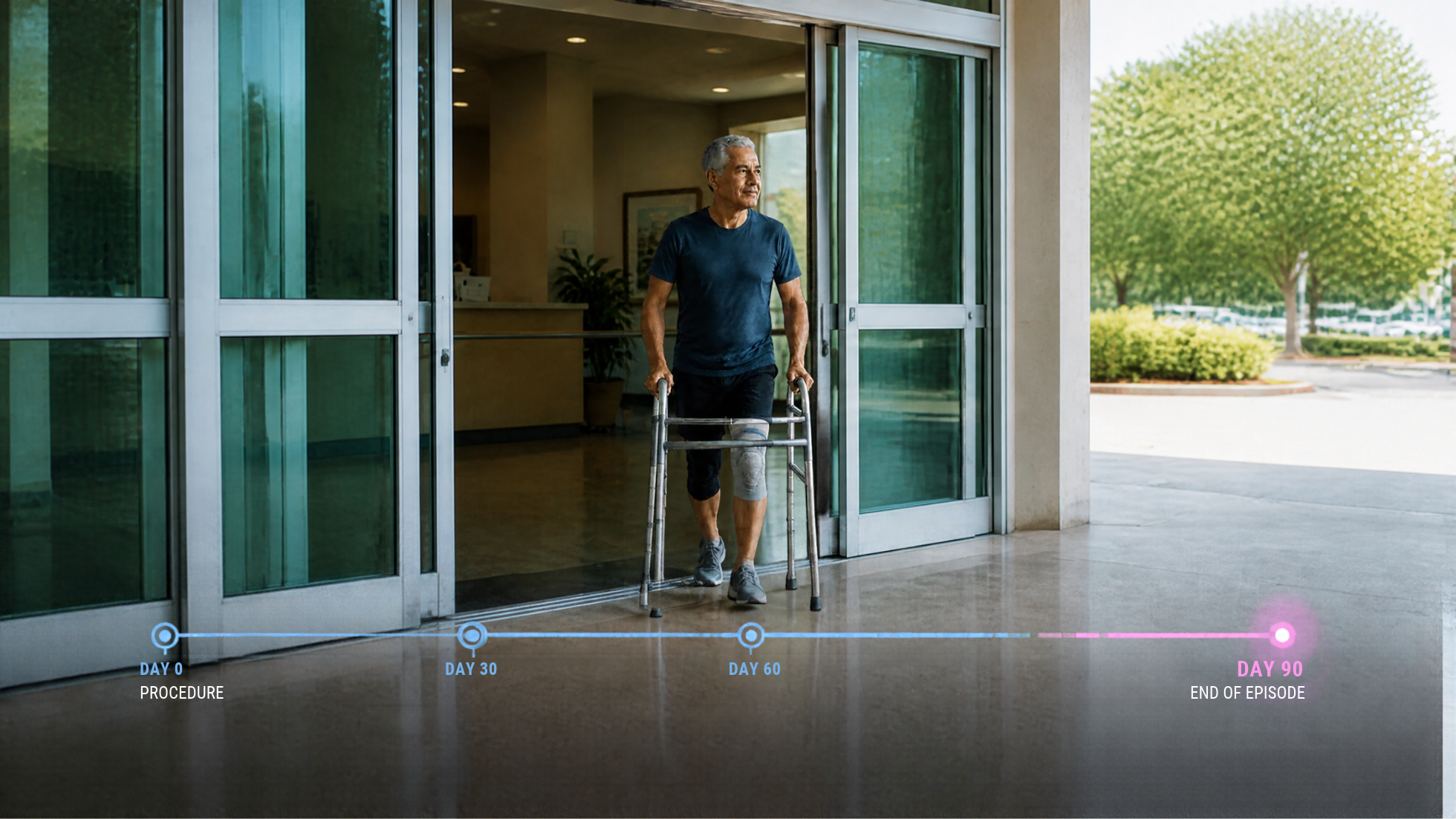
In July 2026, CMS finalized the Comprehensive Care for Joint Replacement Expanded Model. Starting January 1, 2028, more than 2,000 acute care hospitals will be accountable for the cost and quality of joint replacement from the procedure through 90 days after discharge. Unlike TEAM, there's no upside-only track. Money is at risk from the first performance year.

That leaves hospitals one year of runway. Here's what CJR-X requires, how it differs from what came before, and what to put in place first.

Already in TEAM? TEAM hospitals are excluded from CJR-X while TEAM runs, then move into it on January 1, 2031. Everything below is where your 30-day window is headed, and what you build for it now carries straight into a 90-day one.

What is CJR-X and when does it start?

CJR-X is a mandatory, nationwide bundled payment model for lower extremity joint replacement. It was finalized in the FY 2027 IPPS final rule and begins January 1, 2028, with performance years that follow the calendar year.

Key details:

  • Who: All acute care hospitals paid under both the inpatient and outpatient prospective payment systems, more than 2,000 in total. Maryland hospitals, Critical Access Hospitals and current TEAM participants are among those excluded.
  • Which procedures: Inpatient hip, knee and ankle replacements, and outpatient hip and knee replacements.
  • How long: From the procedure through 90 days after discharge, covering Medicare Part A and B services, including physical therapy and post-acute care.
  • How much risk: Two-sided from year one. Most hospitals face up to 20% stop-loss and 20% stop-gain. Rural, Medicare-dependent, sole community and safety net hospitals have a 5% stop-loss.
  • How it's scored: Spending is reconciled against regional target prices, not each hospital's own history.

For TEAM hospitals, CJR-X is the next step. When TEAM ends, its hospitals move into CJR-X on January 1, 2031.
‍

Why the 90 days after discharge matter most

CJR-X runs three times longer than TEAM's 30-day window. That longer window carries more of the cost. In the BPCI Advanced program, more than 40% of joint replacement episode spending happened after the initial procedure and stay.

Quality follows the same pattern. CJR-X scores hospitals on a composite of measures that includes complications within 90 days of hip and knee replacement, patient experience and patient-reported functional outcomes. Strong quality performance lowers the discount CMS applies to the target price, from 2% down to 1% or even 0%.

CMS also watches the 30 days after the episode closes. Hospitals whose spending in that period runs far above their region can owe a repayment outside the usual stop-loss limits.

The result: the stretch of recovery hospitals see least is now the stretch they're paid on most.

Figure 1

CJR-X triples the window. The check-ins stay the same.

TEAM covers 30 days after discharge. CJR-X covers 90, and CMS watches spending for 30 days after that. Most patients still have two scheduled follow-up visits.

TEAM 30 days CJR-X 90 days Spending monitored 48 days, no scheduled visit 2-week visit 6-week visit Discharge Day 30 Day 60 Day 90 Day 120

Swipe sideways to see the full chart.

Follow-up timing varies by program; two- and six-week visits are typical after hip and knee replacement. Source: CMS FY 2027 IPPS final rule.

How should hospitals prepare for CJR-X?

The original CJR model, which ran in selected regions starting in 2016, is the clearest playbook. Its evaluation found that hospitals did better when surgeons were engaged and post-acute care was coordinated, and that hospitals new to bundles needed more time to redesign care.

Three areas are worth starting on in 2027:

  1. Know your numbers. Pull your current episode cost, post-acute mix and readmission sources, broken out by surgeon and site of care. Target prices arrive before each performance year; your own baseline shouldn't wait for them.
  2. Bring surgeons and post-acute partners in early. CJR-X holds the hospital accountable, but surgeons and the post-acute network shape most of the cost. Shared pathways and partner agreements take months to build.
  3. Plan how quality gets measured. The quality score combines complications, patient experience and patient-reported functional outcomes. Collecting outcomes reliably across a 90-day episode is an operational project, not a form.

What changes when the bundle runs 90 days instead of 30?

For TEAM hospitals, 30 days already felt long. CJR-X triples the window, and that changes the work.

  • Recovery has more time to stall. Across 90 days, the risk isn't only an early complication. It's a recovery that plateaus between the two-week and six-week visits, or therapy that tapers off before the patient is back to full function.
  • More of the episode happens outside the hospital. CJR-X includes outpatient hip and knee replacements, and nearly three in four of these procedures are now done in outpatient settings. Fewer hospital days means more of the recovery happens at home.
  • Many teams are building this for the first time. Hospitals new to bundles won't have episode-level care coordination, post-acute partnerships or recovery tracking already in place.

All three point to the same need: knowing how each patient is progressing across the full window, not only at scheduled visits. We've written about how health systems are building that visibility under TEAM in From Discharge to Data. CJR-X asks for the same thing over three times as long, at far more hospitals.

The signal doesn't have to be complicated. Walking is one of the clearest indicators of how a joint recovery is going, and a 0.1 m/s drop in gait speed is associated with a 10% higher readmission risk. Tracked from a pre-op baseline across all 90 days, it shows which patients are progressing and which have stalled.

Figure 2

A stalled recovery shows up two weeks before the next visit.

Two joint replacement patients, measured every day from their own phones against a pre-op baseline. One stays on the expected recovery path. One plateaus.

Pre-op baseline Surgery Expected recovery range Patient A Patient B Caution, day 28 Off expected recovery path 2-week visit 6-week visit Day 90 Walking vs. pre-op baseline

Swipe sideways to see the full chart.

Day 42When Patient B's stall would surface at the next scheduled visit
Day 28When daily walking data flags Patient B as off the expected path

Illustrative example with sample data, not real patients.

‍

Where OneStep fits

OneStep turns any smartphone into clinically validated movement intelligence, with no wearables or extra hardware. For joint replacement programs, that means:

  • A walking baseline before surgery
  • A daily recovery trend after discharge, measured from the patient's own phone
  • A clear view of who is on track and who is falling behind
  • Objective recovery data that supports the outcomes patients report

OneStep is FDA-listed, validated against six gold-standard gait labs and backed by 35 billion steps analyzed.

CJR-X gives hospitals one year to get ready. The programs that use it to build visibility into the 90 days after discharge will start 2028 knowing which patients need them.

See how OneStep spots the patients who aren't recovering as planned.

‍

‍

Sources