
An impact analysis by Signature Rehab
Download the full story
“OneStep has transformed our practice. Finally a tool that helps prevent rather than react.”
Christine Busby, MS, CCC-SLP, MBA, Chief Operating Officer, Signature Rehab
Signature Rehab, a contract therapy provider working across skilled nursing, long-term care, restorative and memory care, built a three-tiered fall-mitigation model on OneStep's objective gait data. In the facilities that used it most, falls came down — and so did rehospitalizations, one of the quality measures that payers and networks use to choose their partners.
Traditional fall prevention is reactive: the incident report triggers the intervention, and fall risk is assessed at fixed points with little visibility in between. The early signs of decline — which typically appear 10–14 days before a fall — go unseen, and the same blind spot sends residents back to the hospital.
Signature Rehab turned fall prevention into a continuum, measuring residents with OneStep's smartphone gait analysis in three tiers. At admission, every resident gets an objective baseline. During restorative care, risk is tracked day to day without adding staff burden. And when the data shows rising risk — a widening gait asymmetry, a missed dual-task flag — the resident gets a same-week reassessment and therapy referral instead of waiting for the next scheduled screen. Residents leaving therapy carry an updated baseline back to long-term care or home.
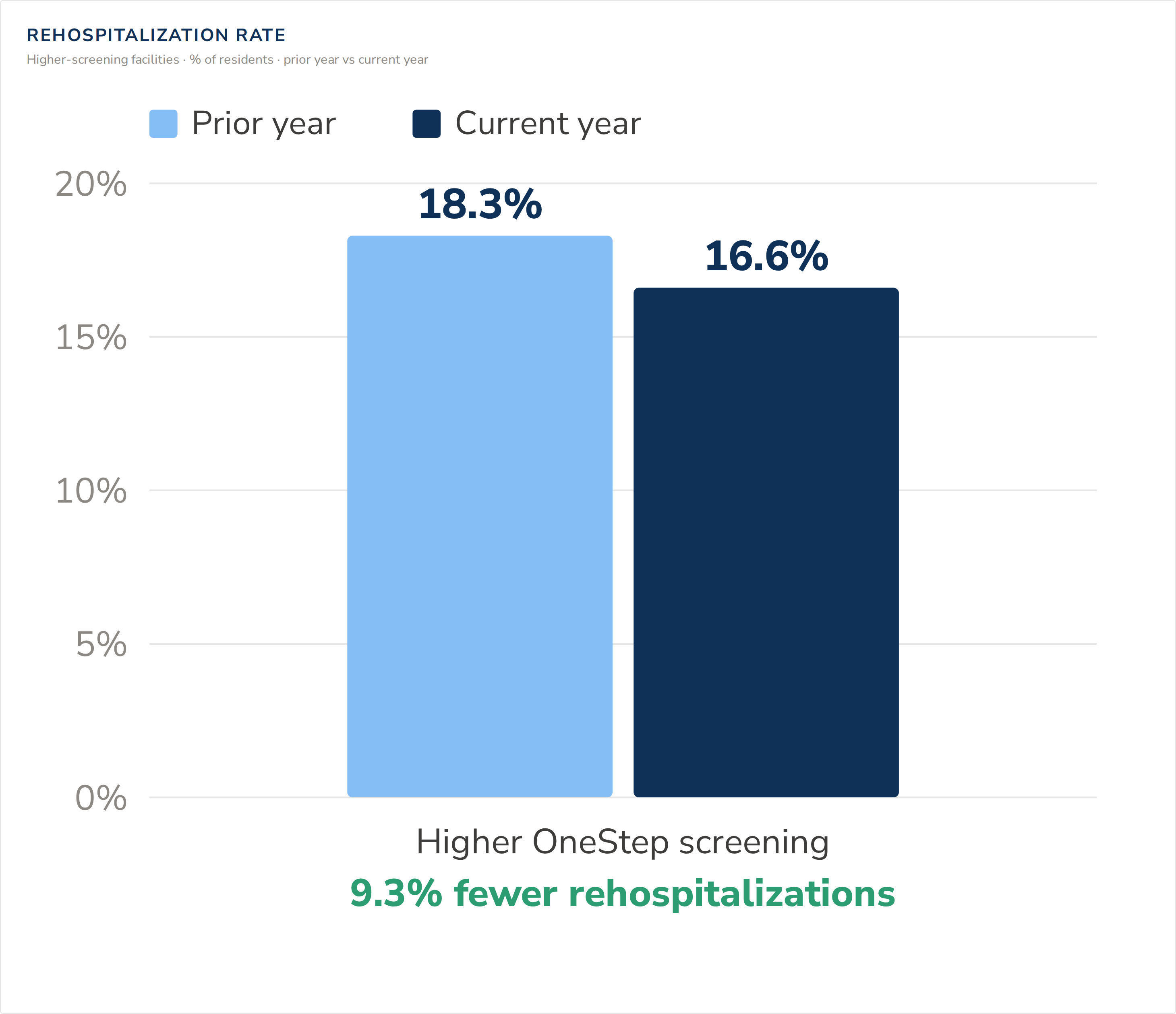
Rehospitalization rate - higher-screening facilities, prior year vs current year
Facilities that screened residents with OneStep most often saw falls fall from 22.5% to 18.5% of residents; facilities that screened less saw falls rise 11.1%. In the higher-screening facilities, rehospitalizations dropped from 18.3% to 16.6% — 1.7 points, or about 17 fewer rehospitalizations per 1,000 residents. At $18,100 per Medicare readmission, that is roughly $300,000 in avoided hospital costs per 1,000 residents, on a measure that also drives SNF Value-Based Purchasing, where 2% of Medicare Part A payments are at stake.
One resident shows what that looks like. Linda, 79, saw her gait speed slip from 0.6 to 0.5 metres per second — almost nothing on paper, but a decline that small is linked to a 7% increase in fall risk and a 12% increase in mortality risk. OneStep notified her care team the moment her stride consistency, step asymmetry and double support shifted. She was referred back to therapy before anything happened, improved quickly, and stayed safe and independent in her community.
The decline no one could see became the fall that never happened.