

Ruth is in her late sixties and lives at home. Her lower back has slipped out of alignment — spondylolisthesis — and arthritis in both hips and both knees had made every step a decision. By the summer of 2024 she had finished a course of home physical therapy. She was walking better, she was stronger, and she liked her therapist. Ordinarily this is where the story ends: discharge, a printed exercise sheet, a promise to call if anything changes. Patients rarely call.
Declines in people like Ruth are gradual and happen between visits, when nobody is watching. By the time anyone notices, the result is often a fall. Her therapist wanted a way to keep following her after the last home visit — without turning every week into another visit.
Instead of discharging Ruth, her therapist moved her to a remote care program with OneStep, covered under Remote Therapeutic Monitoring. Ruth kept her home exercise program in the app, kept a phone in her pocket on her walks and answered a short functional questionnaire every week or so. In eight weeks she recorded 583 walks and was active in the app on 52 of 56 days. Every walk was measured — speed, symmetry, how long both feet were on the ground — and tracked against her own baseline. Her therapist could see all of it, and would be notified if anything changed.
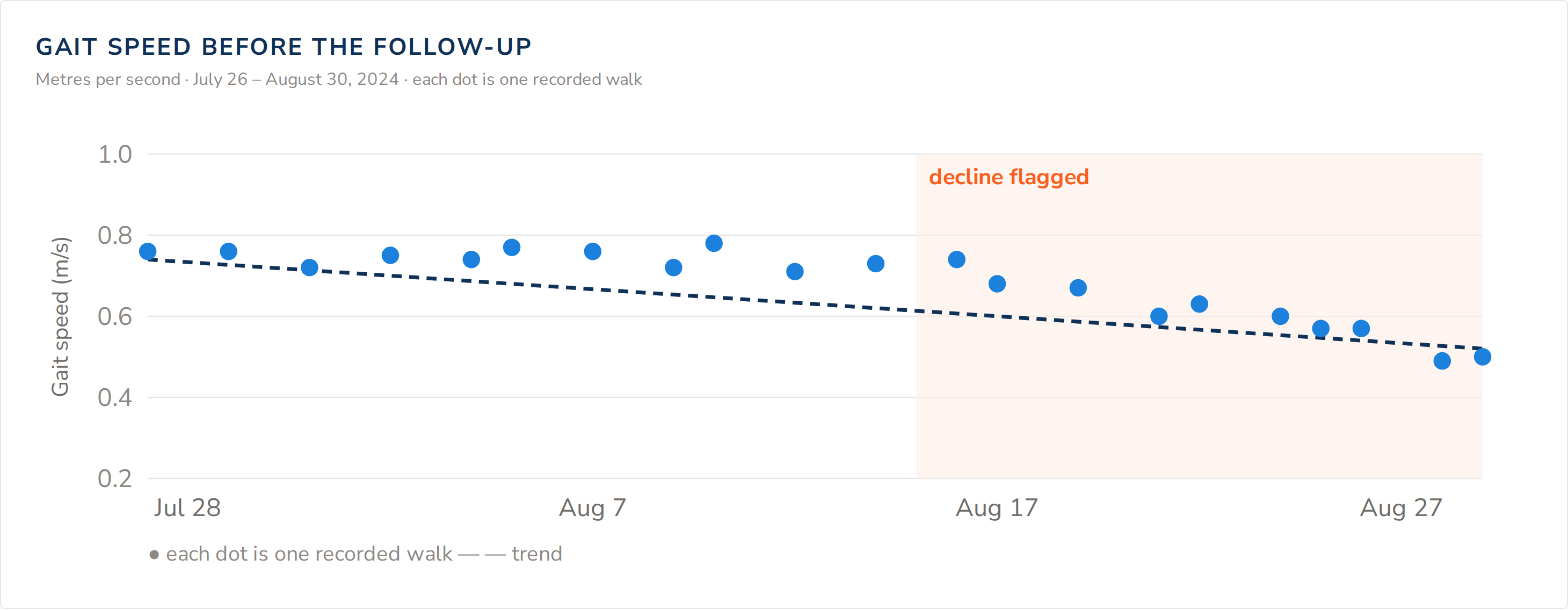
In the week of August 15, three numbers moved the wrong way at once: her step-length asymmetry rose, she spent longer with both feet on the ground, and her gait speed fell. None of it would be visible in a hallway. Her own functional score, answered in the app, fell from 8.3 out of 10 to 3. OneStep flagged the trend and notified her therapist, who looked at which parameters had moved and booked a telehealth visit that week. On the call Ruth said she had lost a close friend; she had stopped doing her exercises and was barely leaving the house. The plan changed that day — a program she could manage, support for what she was going through, and the walks kept going. Over the next ten weeks her gait speed climbed back and then past where it had been.
A quarterly check-in would have found Ruth in October. A fall might have found her sooner. OneStep found her in the first week.