
The playbook of six OneStep providers
Download the full story
“OneStep has been an amazing addition to our team's toolbox. We're already seeing great outcomes, patient engagement and extensions of care.”
Kelli Baumert, Vice President, Blue Stone Therapy
Most of OneStep's senior living and contract therapy partners start with Remote Therapeutic Monitoring. The return is immediate and it pays for the program. But the partners who get the most out of OneStep do something more with the same data: they use it to find the residents who are declining, refer them into care, and justify that care to the payer. That is where the return — and the outcomes — really are.
A resident's balance drifts over weeks, and the standard fall-risk assessment happens at admission and once a quarter. Between those points, decline is something a nurse might notice in the hallway, or might not. Therapy providers learn about it from nursing reports, after the fact, so residents who should be back on skilled therapy are not referred, and Managed Care plans that want evidence before approving another week of care rarely get it. Care is discharged while it is still needed, and falls — about $50 billion a year in medical spending — keep happening.
A resident walks with a phone in a pocket and the care team has gait speed, asymmetry, a Walk Score and a fall-risk level in minutes. Because every walk is also an RTM event, teams measure every resident routinely — one partner earns about $102 per monitored resident per month, a quarter of it passively from the app monitoring the phone. Routine measurement is what finds the decline: a Walk Score trending down, a fall-risk level moving to very high, a care action flagging a drop in gait speed. The same objective data goes into the referral, the letter of medical necessity or the extension request, in a form payers accept.
“OneStep is by far the easiest tool I've used. We explored countless options — VR, wearables, ambient sensors — but nothing comes close. Beyond its clinical impact, the financial results have been remarkable.”
Dan Reizis, CEO, Prestige Rehab
Partners refer two to five residents per community per month into therapy who would otherwise have been missed. Choice Rehabilitation had Managed Care Part A extensions approved at an average of 5.5 additional days, about $500 a day, and earned $7,243 from extensions and RTM in its first sixty days. One five-facility therapy provider earned $195,000 in a year — RTM grew 3.4×, but care extensions grew five-fold and made up four-fifths of the total. And across 75 communities measured over six months, 85% of residents improved or maintained function and at least 117 falls were avoided, about $877,500 in cost that was never incurred.
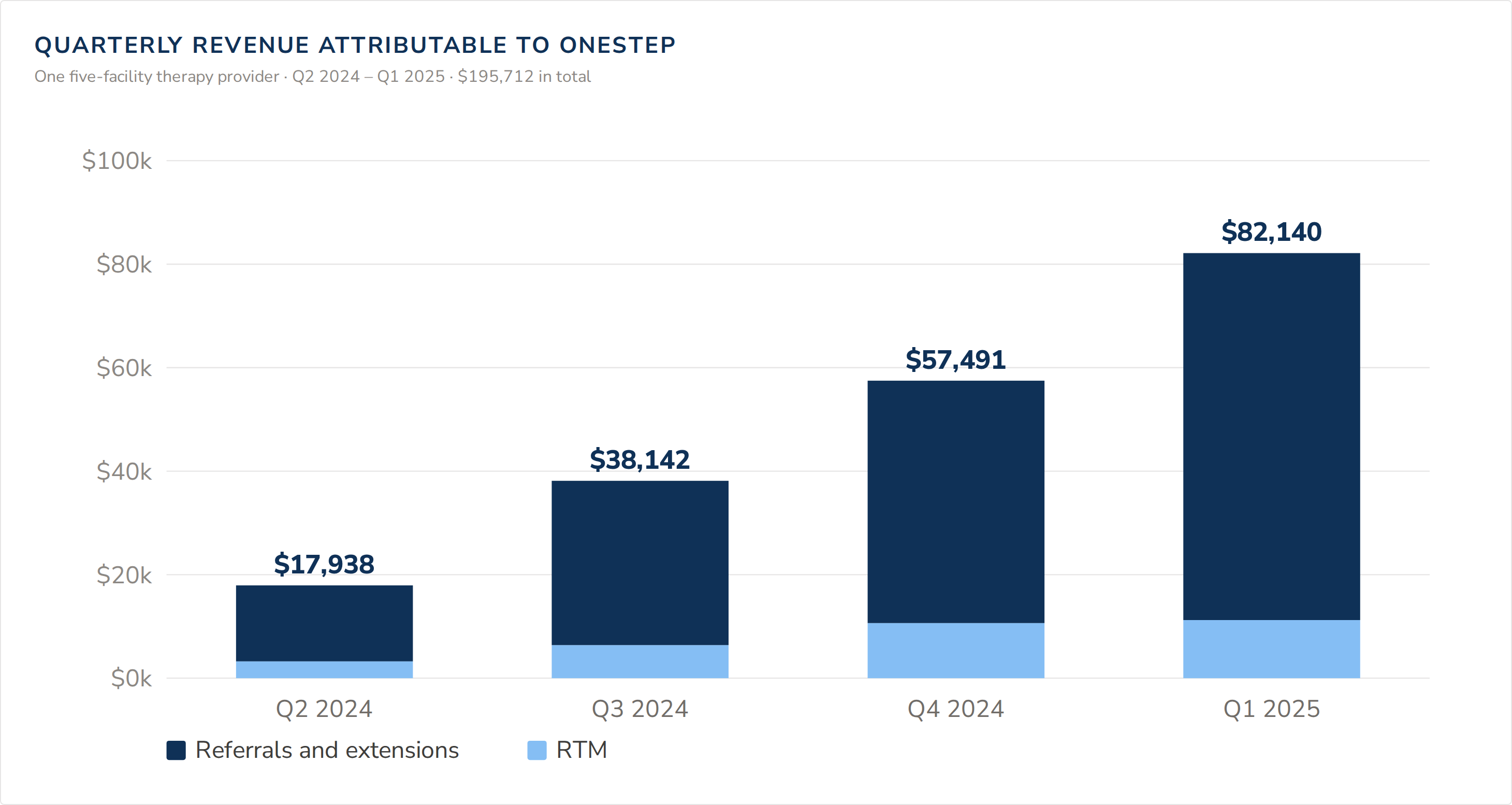
Quarterly revenue attributable to OneStep - one five-facility therapy provider, Q2 2024 to Q1 2025; care extensions in navy, referrals in blue, RTM in light blue
“We have not only seen a sharp decline in falls, but also a boost in quality and efficiency of documentation.”
Cassie Murray, Chief Operating Officer, HTS
RTM gets a team measuring every resident. Measuring every resident finds the decline. Finding the decline earns the extension — and prevents the fall.
“With OneStep we identify 2–3 residents each month in each facility who could benefit from care. We could not have identified them otherwise.”
Christine Busby, Chief Operating Officer, Signature Rehab