
A story from Kinomatic
Download the full story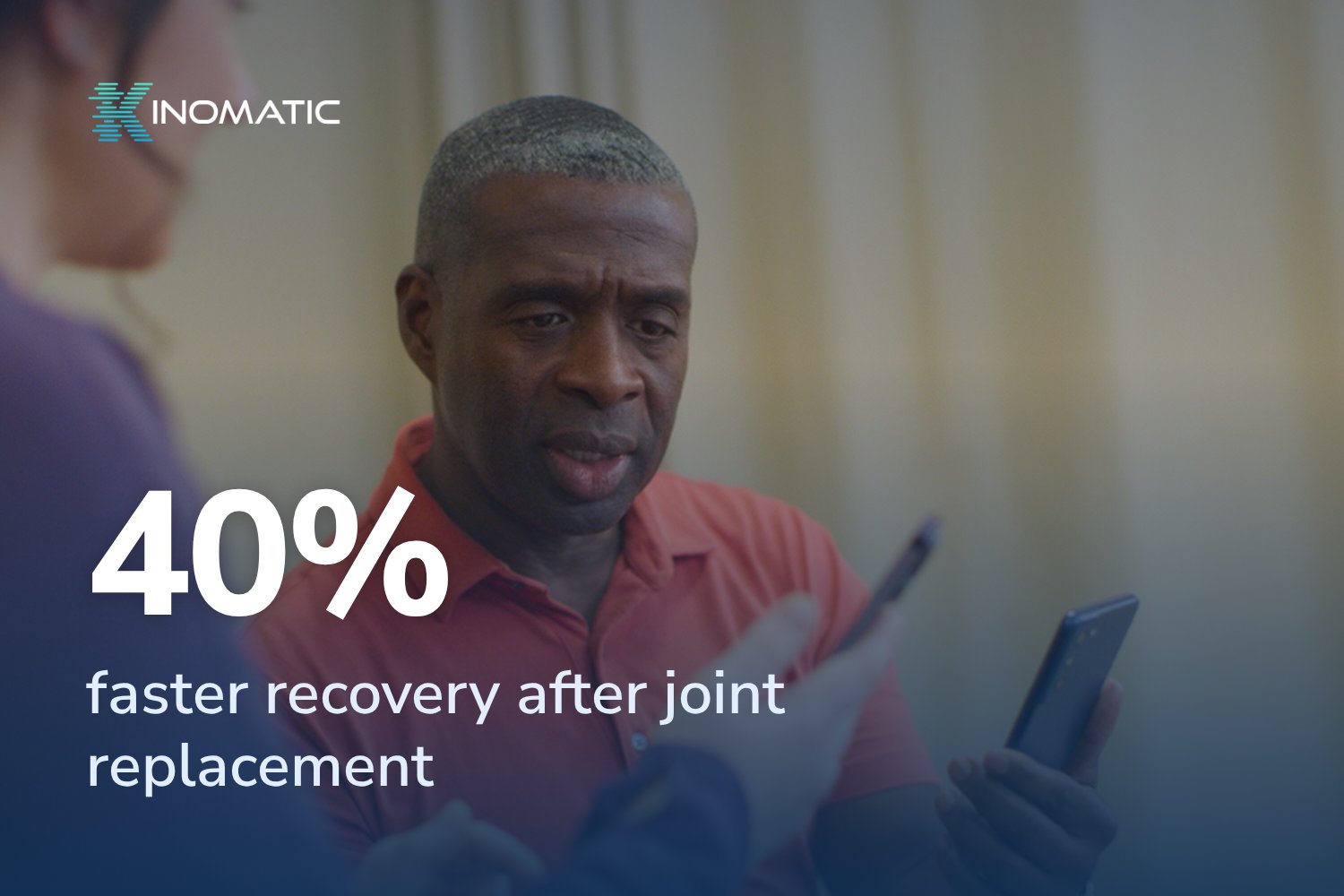
“Kinomatic is committed to delivering the best possible outcomes for our patients, and OneStep has been a game-changer in making that vision a reality. Their ability to capture real-world gait data with accuracy and ease has given us the proof we need to demonstrate the high efficacy of our approach.”
Brian Wyss, Chief Operating Officer, Kinomatic
Kinomatic plans every joint replacement on a 3D model of the patient's own bones, built from a CT scan, before the surgeon makes a cut. The company believed its patients recovered faster. Surgeons saw it. Patients felt it. But a belief is not evidence, and payers, partners and prospective patients wanted evidence.
Total knee and hip replacement leave many patients anxious about what recovery will look like. Patients want reassurance of the best possible outcome; surgeons want reliable data to steer care. Kinomatic, a premium, white-glove pre-surgical planning service, prides itself on removing guesswork from the operating room — and it wanted the same rigor after it. That meant recording objective gait data at scale, in real life, and showing transparently that Kinomatic patients recover faster than patients without Kinomatic planning.
Every Kinomatic patient was invited onto OneStep before surgery. With a phone in their pocket, their gait is measured on ordinary walks — no wearables, no lab — and turned into 30+ parameters and a Walk Score within minutes. A licensed physical therapist follows each patient remotely, with a customized home exercise program, chat and video, plus a daily check-in and a monthly outcome measure. Surgeons compare each patient's recovery against the expected band for their procedure and week, and against the industry's largest gait database. OneStep integrated into Kinomatic's existing systems rather than adding one more.
The first cohort, 126 patients in 2022, set the pattern: patients exercised in the app 3–4 days a week and recorded 3–4 walks a week, rated the experience 8.5 out of 10, reported 28% less pain and 16% better sleep, and every one of them said they would recommend it.
The gait data did what Kinomatic hoped. Tracked week by week after surgery — walk speed, cadence, stride length, step-length asymmetry and double support, for both knee and hip replacement — Kinomatic patients recover 40% faster than patients without the Kinomatic advantage. The claim now rests on measurement, not on a promise.
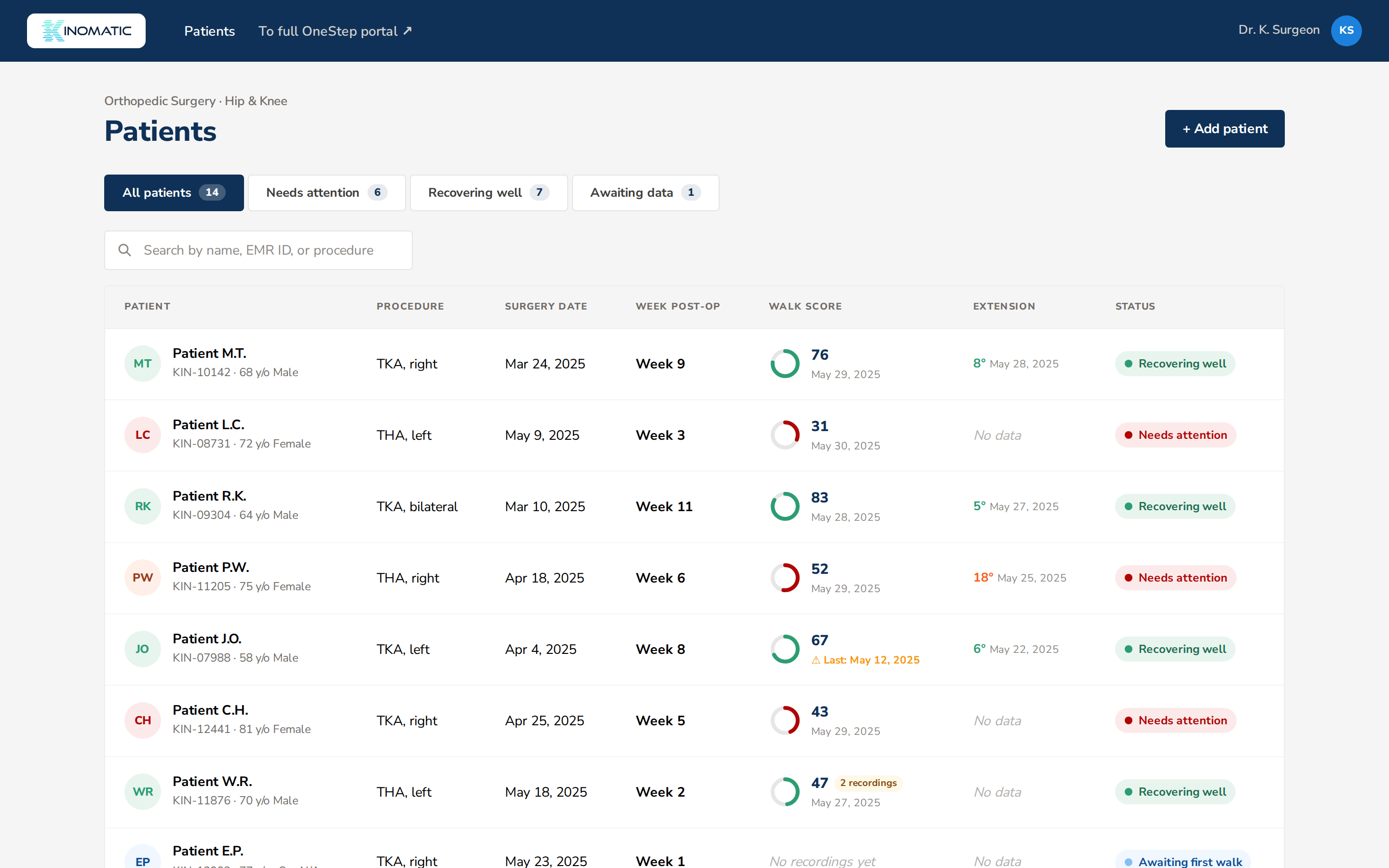
And the measuring never stopped. Four years on, about 2,500 Kinomatic patients have been measured with OneStep, more than a hundred new patients join every month, and patients still use the app roughly four times a week. OneStep now provides Kinomatic with a white-labelled portal under Kinomatic's own brand: every patient's Walk Score against the normal recovery band, the roster sorted by who needs attention, knee extension tracked over time, and objective documentation copied straight into the EMR.
The planning was always precise. Now the recovery is measured to match.
"After surgery, Kinomatic continued to help with their app that tracks my walking measurements so that I can see the improvements on a daily basis. Great experience!"
Elisabeth von Baldas, Kinomatic Patient