
Featuring NovaCare O&P
Download the full story
“OneStep is the easiest tool to use in America."
Stephen Mantegani, NovaCare Prosthetics & Orthotics
A Letter of Medical Necessity isn't written every day, but when it is, it decides whether a patient gets the care, device or brace they need. The difference between approval and denial usually comes down to one thing: objective, defensible evidence. Clinicians at NovaCare Prosthetics & Orthotics, a Select Medical company, use OneStep to put that evidence in the letter.
The challenge
Whether it's an extension of care, a therapy referral, an assistive device or a brace, the letter has to show why the service is medically required. Too often it relies on phrases like "still unsafe" or "improved stability" — observations a reviewer can't verify. Denials follow, appeals drag on, and patients end up paying privately or going without.
How OneStep helped
With OneStep, a patient walks with a smartphone and the clinician gets objective movement data in minutes: speed, step-length asymmetry, double support, a Walk Score and a fall-risk level, each compared with age-matched norms and tracked over time. That data goes straight into the letter and the EMR — a trend graph showing progress and continued need, a side-by-side comparison of a walker and a rollator, or a walk with and without a brace recorded in the same visit.
Stephen Mantegani, NovaCare O&P - on how easy OneStep is to use
What changed
The letters stopped asking reviewers to take a clinician's word for it. An 81-year-old who had improved but wasn't yet safe to discharge was approved for an extension when the letter showed both his progress and his remaining gait deviations against normative values. An 82-year-old who looked independent was approved for therapy once his measured risk was on the page. A rollator was approved as the least restrictive device after a side-by-side comparison, and a neuromuscular brace was prescribed on a 9-point Walk Score improvement measured in the same visit. Each successful extension appeal is worth about $2,160 and each referral about $750 — and fewer denials, shorter appeals and no out-of-pocket costs for patients who need the care.
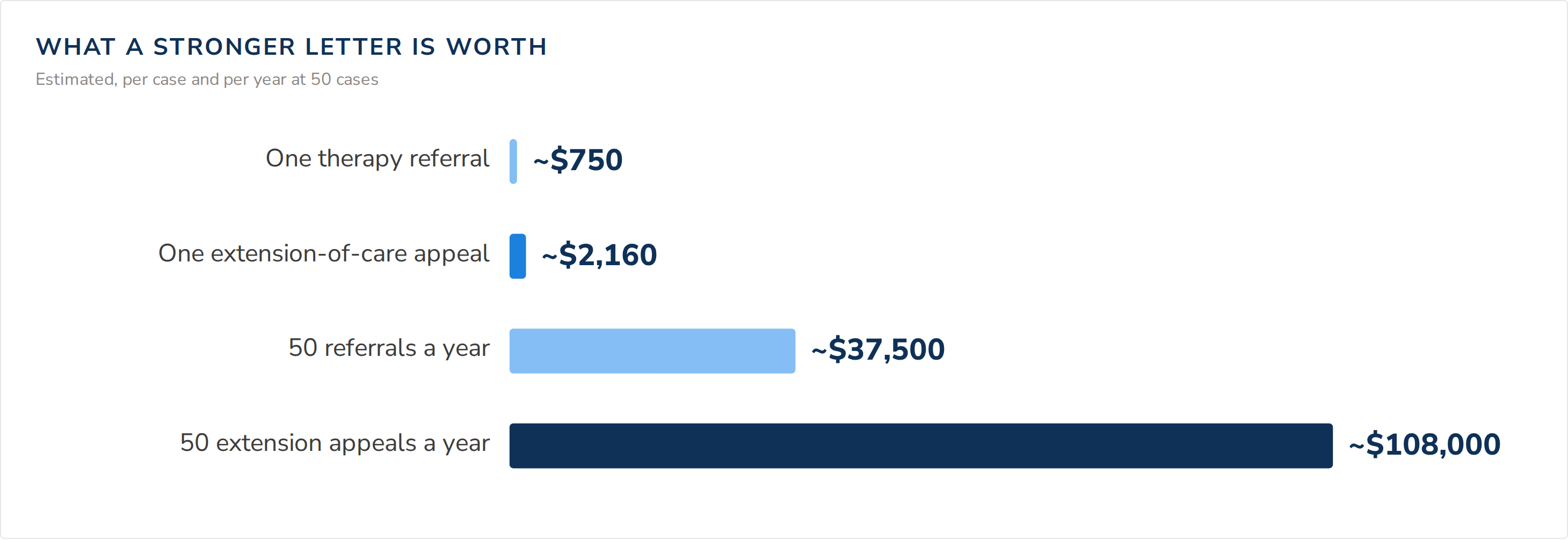
What a stronger letter is worth - estimated per case and per year at 50 cases
When the evidence is objective, approvals become less about opinion.