A story from a large OneStep CCRC partner
Download the full story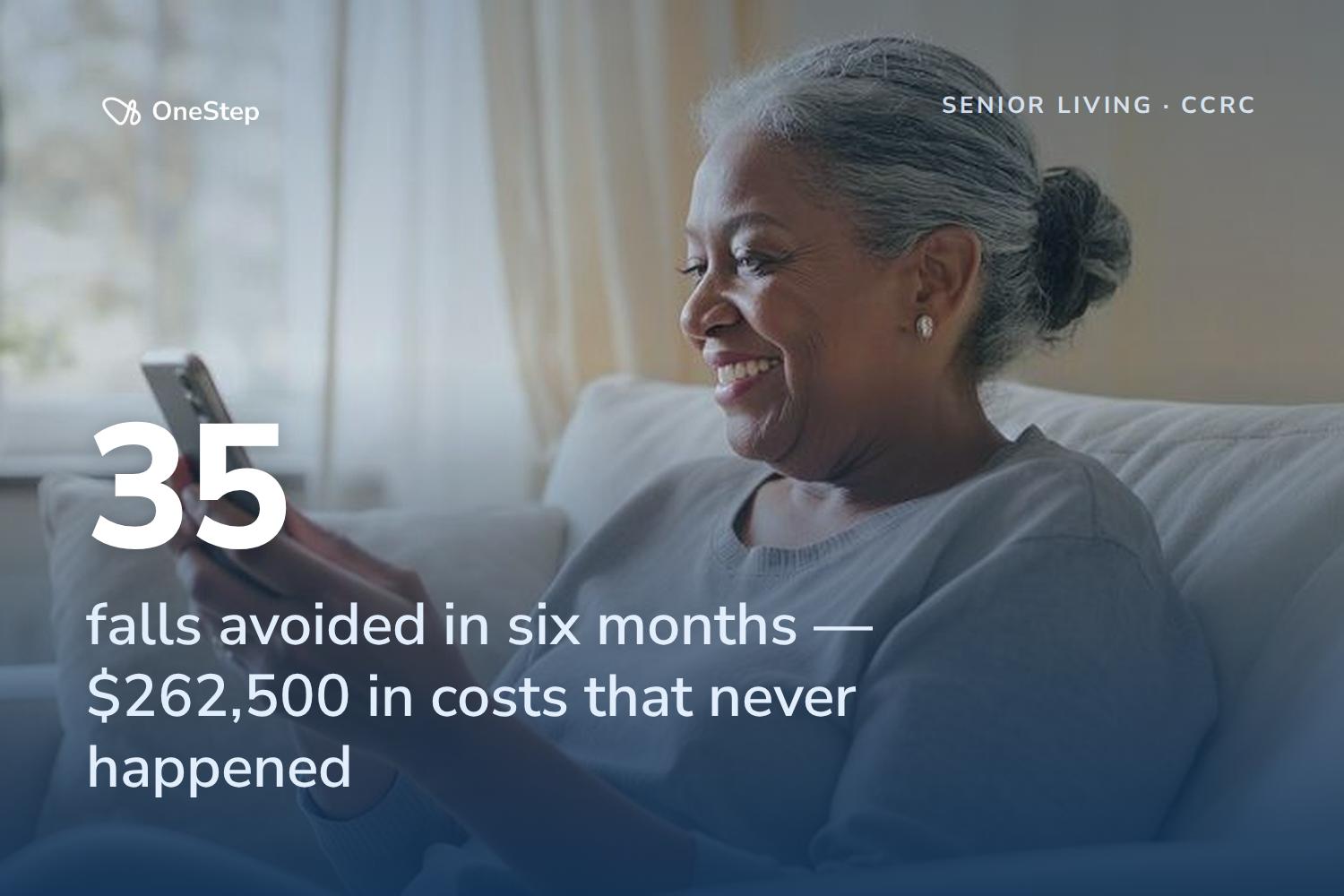
“If prevention works, we need to be able to show it — clinically and financially. OneStep has clearly shown it.”
Director of Rehab, a senior living organization
This story comes from a large continuing care retirement community operator in the United States with its own in-house therapy team. The name is withheld at the organization's request to keep its financial information private. Here, as at many OneStep partners, the platform is used by the therapists, by nursing and by ownership — the same data, in the same place. The unique part of this story is what happens when nursing and therapy teams use OneStep to work together around a shared fall prevention program.
Therapy and nursing worked separately. Nursing saw residents every day but had no objective measure of how they were walking; therapy had the measures but saw a resident only while they were on caseload, then lost sight of them at discharge. Fall-risk assessments were episodic and done differently by different clinicians, so nothing could be compared across units or buildings. When a resident declined between visits, nursing might notice and therapy might not hear about it — or the other way round. There was no shared information and no shared definition of who was at risk, so there was no alignment around falls: each team had its own list, and ownership, which carried the cost of every fall, had no way to see either one. The fall protocol was reactive because, without a common signal, it could not be anything else.
In mid-2025 the organization introduced OneStep as a shared platform between ownership and its in-house therapy and nursing teams. Residents are measured on ordinary walks with a phone, so real-world mobility data sits alongside the episodic assessments. Everyone screens the same way. OneStep flags residents whose fall risk is rising, the therapy team uses the data to refer and to justify continued care, and auto-generated notes grounded in the measurements go into the record. Ownership sees the same data rolled up: who is at risk, where, and what prevention is being done about it.
In six months, 525 residents were assessed for fall risk at least twice — 4,397 assessments in all. 86.7% of residents assessed maintained or improved their functional mobility, twice the rate before OneStep, and 105 of them (20%) are now significantly less likely to fall or be injured. OneStep identified 236 residents at high or very high fall risk early. At least 35 falls were avoided — 15% of the 253 residents flagged as high or very high risk — which at about $7,500 per fall is $262,500 in cost that never happened. Documentation time fell by 1,650 minutes per location, and the organization began billing RTM deliberately, earning $4,206 in the first six months, so that proactive care can eventually pay for itself.
Ownership and clinical teams now look at the same numbers and want the same thing.
“I was nervous to hear we're bringing in new technology. But now I'm so happy about it. OneStep has become an indispensable part of my toolbox.”
Clinician, a senior living organization